A forum for participants of the Montreux Document on pertinent international legal obligations and good practices for states related to operations of private military and security companies during armed conflict.
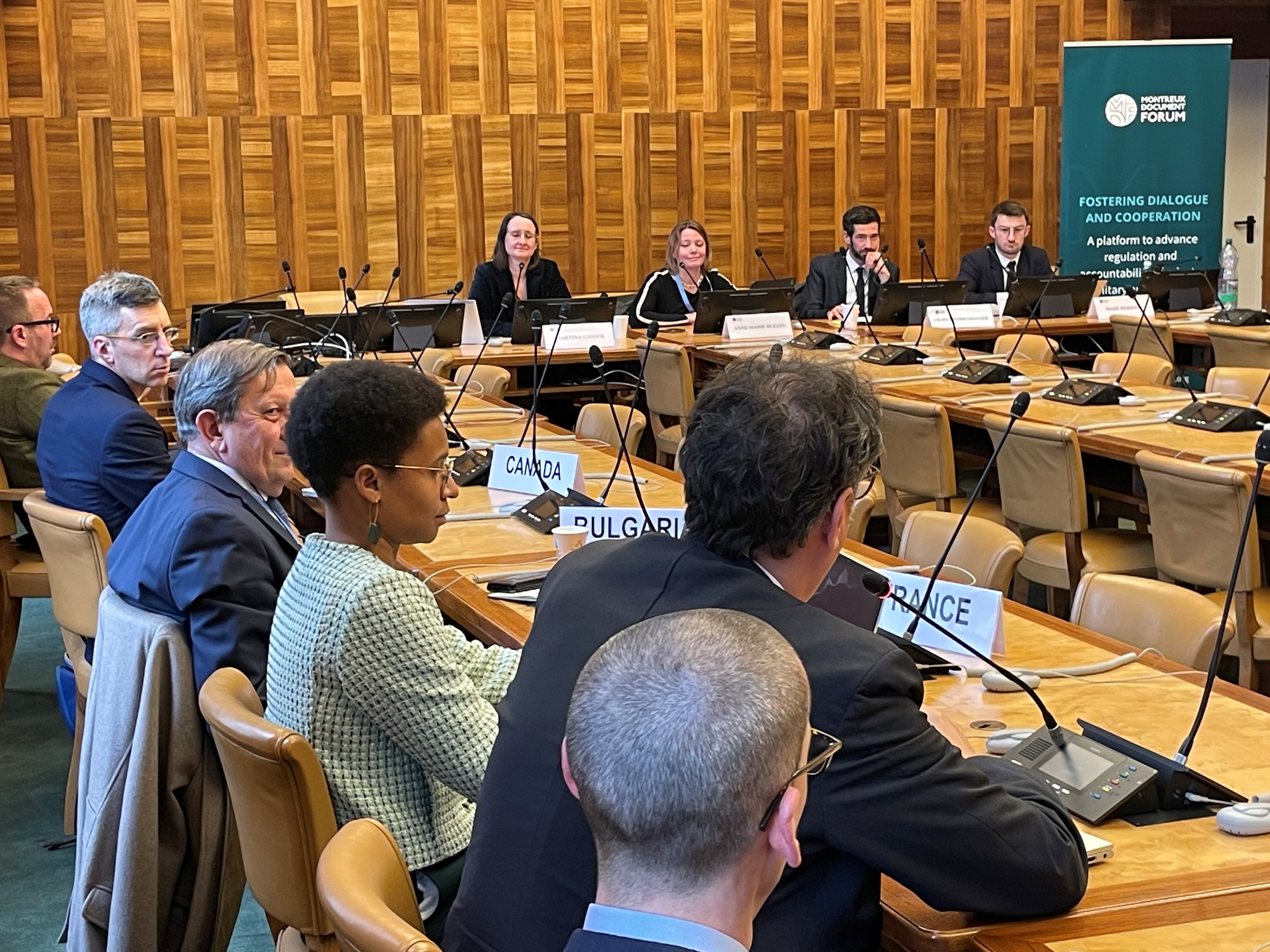
On 1 December, the MDF held a side event at the United Nations in Geneva on PMSCs’ cyber operations in armed conflict.
This side event was held during the informal intersessional consultations for the United Nations’ 7th session of the Open-ended Intergovernmental Working Group on Private Military and Security Companies (PMSCs). The Working Group was established in 2017 to elaborate the content of an international regulatory framework governing the activities of private military and security companies.
The three panelists –from the ICT4Peace
Foundation, the International Committee of the Red Cross, and the French
Ministry of Foreign Affairs– shared their analyses under the moderation of the
Swiss Federal Department of Foreign Affairs. The event brought together 30
participants from various Montreux Document Member States and several civil
society organizations, including ICoCA and TRIAL International.
Panelists started by providing an overview of the shift in services offered by PMSCs beyond traditional roles such as guarding and transporting valuables. They highlighted the growing focus on cyber protection and support, as well as other technology-enabled services, including cloud infrastructure, surveillance and intelligence gathering tools, and AI-powered tools which are now being used both in civilian and military contexts.
Panelists then examined several legal challenges and complexities arising from these developments. The de-territorialized nature of cyber-enabled services further complicates questions of jurisdiction and application of international law. Issues raised included whether the provision of software and hardware for military purposes could constitute direct participation in hostilities, resulting in a loss of protection under international humanitarian law for private service providers. As chains of responsibility and levels of participation in hostilities become more intricate, there is a need to prevent legal loopholes. This requires careful consideration of how existing international legal provisions, such as those contained in the Montreux Document, can apply to these emerging services.
Lastly, panelists reflected on the role of new tools and initiatives in helping to regulate this rapidly evolving industry. This includes ICoCA and the ICT4Peace Foundation’s Comprehensive Guide for Responsible Technology Use by the Private Sector and the Pall Mall Process, which is a multilateral, multi-stakeholder initiative addressing the proliferation of irresponsible commercial cyber intrusion capabilities.